Guides · Underwatering · Water and roots
Is my houseplant underwatered?
Probably, if the leaves are crisping at the edges and curling inward while the compost is dry, dusty, or has shrunk away from the side of the pot. Thirst is the second most common way a houseplant declines — and it is far easier to reverse than the first. A proper soak today and it should perk up within a day. The trap is the fix people reach for: small sips that wet the surface and never reach a root.
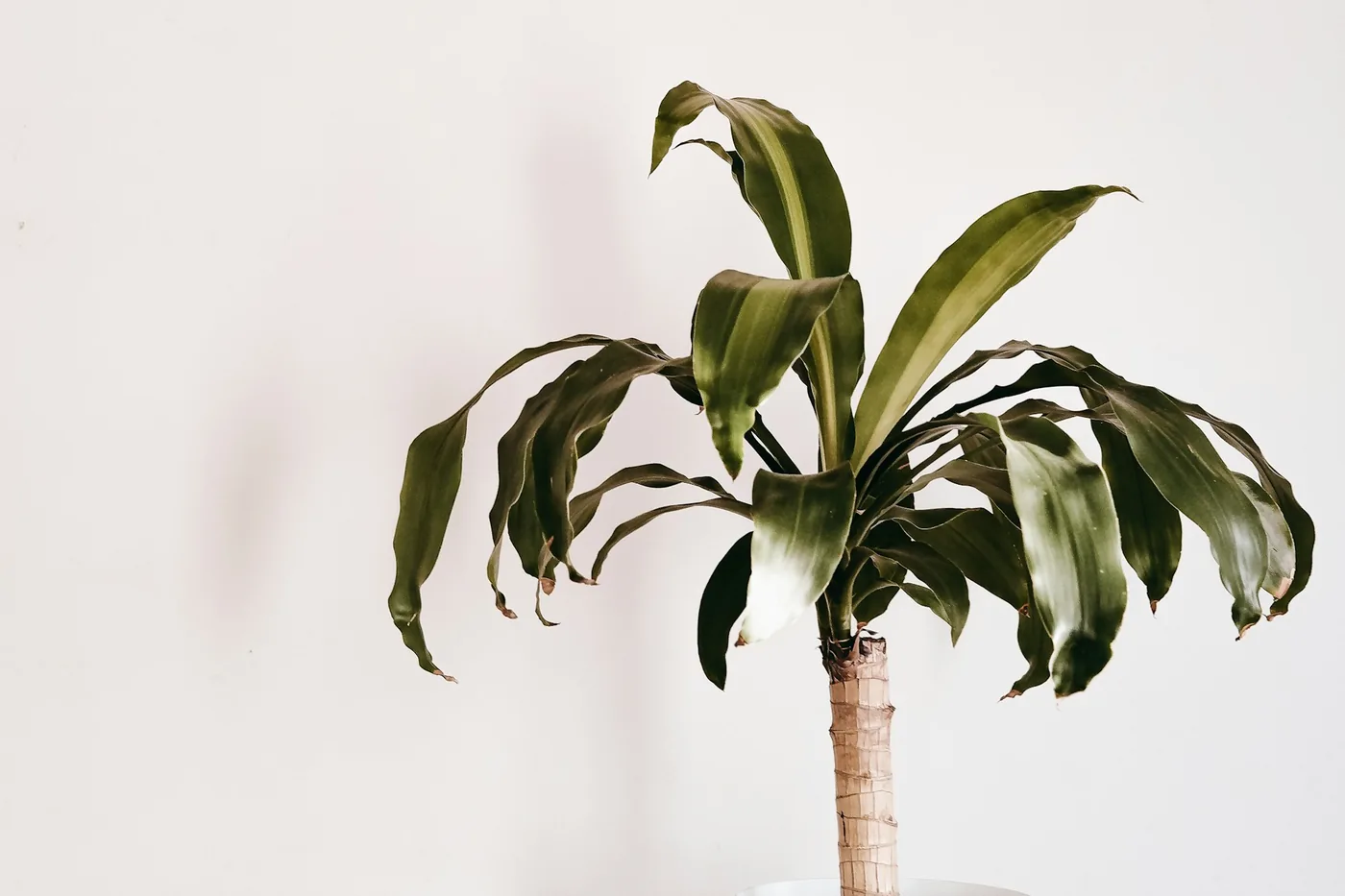
- What it is
- Compost drying out further, or faster, than the plant can cope with — and once fully dry, refusing to take water back in
- The tell
- Crisp edges and curling leaves while the compost is dry. Drowning droops soft, in wet soil
- Urgency
- Low to medium. Soak it today; a wilt recovers in a day, but a leaf that has crisped stays crisped
What is actually happening
A plant moves water from the compost to its leaves through fine root hairs, and those hairs are the first thing to die when the compost dries out. So a plant that has gone dry has lost some of its plumbing as well as its water, which is why it does not always perk up the moment you water it.
The second thing that happens is worse. Peat-based and coir composts, once fully dry, shrink and repel water. The root ball pulls away from the side of the pot, and the next watering runs down the gap and straight out of the drainage holes without wetting anything. The saucer fills, the surface looks damp, and the plant is exactly as thirsty as before. This is the situation in which people conclude that watering "isn't working" and start watering more often — with small amounts, because they are worried about overdoing it — which keeps the top centimetre wet and the roots dry indefinitely.
The fix for both is the same, and it is not "more water". It is one thorough soak that rewets the whole root ball, followed by watering by the soil rather than by the calendar.
The signs
No single sign is proof. The pattern is: the plant looks thirsty and the soil agrees.
- Wrinkled or curling leaves — leaves rolling inward along their length, or a succulent going soft and puckered. The clearest sign, because drowning does not curl.
- Brown, crisp tips and edges. Dry and brittle, snapping rather than tearing. Dry air does this too, so read it with the soil — the peace lily page walks through telling them apart.
- Drooping or wilting while the soil is dry. The decisive one. Push a finger in: if the top few centimetres are dry and the plant is limp, this page is the right page. If they are wet, it is the other one.
- Compost pulling away from the pot, a visible gap round the edge, or a surface that has gone pale, dusty and hard.
- Water running straight through and out of the bottom within seconds, with the compost no darker afterwards.
- The pot is light for its size. Lift it once when it is properly watered and you will know the difference forever.
- Leaves dropping, often the older ones first and often while still partly green, after a stretch of neglect or a spell by a radiator.
Underwatered or overwatered?
The two share a droop, which is why the mistake is so easy in both directions. Everything else pulls the other way.
Underwatered if
- the soil is dry, dusty, or pulling away from the pot
- leaves crisp at the edges and curl rather than soften
- the plant perks up within hours of a proper drink
- water runs straight through and out of the bottom
- the pot is light for its size
Overwatered if
- the soil is wet or damp when you push a finger in
- yellowing starts at the bottom and the leaves feel soft
- the base is soft, or the compost smells sour
- there are gnats, or a green tinge on the surface
- the pot is heavy for its size
If it is the right-hand column, stop here and read the overwatering page: the one thing you must not do to a drowned plant is soak it.
Why now
In a British autumn the heating goes on, and the air beside a radiator or on a sunny sill can dry a small pot in two or three days when it took a week in September. The plants that suffer are the ones in small pots, terracotta pots, and peat-based compost — all of which dry fast — and the ones nobody passes very often. The plant on the landing gets watered when the plant in the kitchen does, which is a schedule for the kitchen.
The other autumn cause is the opposite instinct. Everyone has read that overwatering kills, so the watering can goes away — and a plant that genuinely needed less water in the dim months is joined by one beside a radiator that needed more. The finger test is the whole answer: it makes the plant tell you, rather than the month.
What to do
- Soak the whole pot, not the surface
- Stand the pot in a basin, sink or bucket of room-temperature water that comes two-thirds of the way up the pot, and leave it for 20 to 30 minutes — until the surface is dark and the bubbles have stopped. This is the only way to rewet compost that has shrunk and gone water-repellent; watering from the top runs round the outside.
- Then let it drain fully
- Lift it out and let it stand until nothing more drips — ten minutes, or longer for a big pot. Do not put it back in a cover pot or on a saucer while it is still draining: a plant sat in its own run-off has just swapped one problem for the other.
- Move it off the radiator and out of the draught
- Not to a dark corner — just a foot or two from the heat source, or off the sill that bakes at midday. The point is to stop the compost drying faster than you can keep up with.
- Leave the crisp leaves for now
- A leaf that has gone crisp will not recover, but it is not harming anything. Take it off once it is fully brown, or once the plant has clearly recovered; cutting a struggling plant back hard is a second shock it does not need.
- Then water by the soil, not the calendar
- Push a finger in before every watering. Water thoroughly when the top few centimetres are dry — until it runs from the drainage holes — let it drain, and check again in a couple of days rather than a week. That one habit prevents both of the ways a houseplant dies of water.
What not to do
- Do not give it small sips "little and often". They wet the top centimetre, the roots stay dry, and the surface staying damp is what convinces you it has been watered.
- Do not water a bone-dry pot from the top and walk away. If the compost has shrunk, the water goes round it. Soak it once.
- Do not feed it. Fertiliser in dry compost concentrates round the roots and burns them; feed again a fortnight after it has recovered.
- Do not repot it while it is wilting. A repot is a shock; let it recover in the pot it is in, then repot in spring if it was genuinely pot-bound.
- Do not overcorrect. One soak, then the finger test. The plant that was underwatered in October is very often the one that is overwatered by December.
- Do not mist it as a substitute. Misting wets leaves for twenty minutes and does nothing for the roots.
How you know it is working
A wilting plant should perk up within a day of a proper soak — often within hours. Curled leaves relax; the pot is heavy again; the compost has come away from the sides of the pot no further. New growth over the following weeks will be normal, and the crisp edges stay where they are.
If it stays limp two days after a full soak and drain, the roots may have died back further than the leaves suggested. Tip it out and look: pale, firm roots mean patience; brown, mushy ones mean it was never thirst at all, and the root rot page is the one you need.
This page names categories, not products, on purpose. Availability and approval change; what works does not.
Common questions
How do I know if my plant is underwatered?
The compost is dry an inch or more down, often pale, dusty and shrunk away from the side of the pot, and the pot feels light. The leaves fold, curl or go crisp at the edges and tips rather than soft. If the compost is wet and the plant still droops, it is the opposite problem — roots that can no longer drink — and more water will make it worse.
Can an underwatered plant recover?
Nearly always, and quickly: a wilt from thirst usually lifts within a day of a proper soak. What does not recover is a leaf that has already gone crisp — cut those off once the plant has picked up. If it stays limp two days after soaking, check the roots; a plant left bone dry for weeks can lose enough of them to need time rather than water.
How do I water a plant that has dried out completely?
Not from the top, at first — dry compost repels water and it runs straight down the gap at the side of the pot. Stand the pot in a bowl or sink with a few centimetres of water for twenty to thirty minutes until the surface darkens, then let it drain fully. After that, water normally; the compost will hold water again once it has been re-wetted.
Why is my plant dry again two days after watering?
Because the roots have filled the pot and there is almost no compost left to hold water, or because you are giving small sips that wet the surface and never reach the roots. Slide the plant out: a solid mat of roots means it wants a pot one size bigger and fresh compost. If there is plenty of compost, water more at once and less often.
Should I mist an underwatered plant?
No. Misting wets the leaves for a few minutes and does nothing for the roots, which is where the water is needed. Soak the compost; if the air in the room is dry as well, grouping plants together or a tray of wet gravel under the pot does more than a mist ever will.
Plants this often affects
Species in the Sabz catalogue whose common problems include this one. Each page has the watering interval and the toxicity verdict for cats and dogs.
- Aloe VeraAloe vera
- Areca PalmDypsis lutescens
- Asparagus FernAsparagus setaceus
- BasilOcimum basilicum
- Bird of ParadiseStrelitzia reginae
- Burro's TailSedum morganianum
- Christmas CactusSchlumbergera bridgesii
- ChrysanthemumChrysanthemum morifolium
- ColeusPlectranthus scutellarioides
- CrotonCodiaeum variegatum
- EcheveriaEcheveria elegans
- Emerald Ripple PeperomiaPeperomia caperata
- English IvyHedera helix
- Fiddle Leaf FigFicus lyrata
- HaworthiaHaworthia fasciata
- Heartleaf PhilodendronPhilodendron hederaceum
- Inch PlantTradescantia zebrina
- Jade PlantCrassula ovata
- Living StonesLithops
- Maidenhair FernAdiantum raddianum
- Money TreePachira aquatica
- Monstera (Swiss Cheese Plant)Monstera deliciosa
- Moth OrchidPhalaenopsis hybrid
- Nerve PlantFittonia albivenis
- Norfolk Island PineAraucaria heterophylla
- Peace LilySpathiphyllum wallisii
- Pencil CactusEuphorbia tirucalli
- Pincushion CactusMammillaria fragilis
- Polka Dot PlantHypoestes phyllostachya
- Ponytail PalmBeaucarnea recurvata
- Prayer Plant (Calathea)Goeppertia orbifolia
- Prayer Plant (Maranta)Maranta leuconeura
- Prickly PearOpuntia species
- Rubber PlantFicus elastica
- Satin PothosScindapsus pictus
- Snake PlantDracaena trifasciata
- String of HeartsCeropegia woodii
- String of PearlsSenecio rowleyanus
- Sweetheart HoyaHoya kerrii
- Watermelon PeperomiaPeperomia argyreia
- Wax PlantHoya carnosa
- Brazilian OrchidSophronitis species
- Busy LizzieImpatiens walleriana
- ChivesAllium schoenoprasum
- Christmas OrchidCattleya trianae
- Cocktail OrchidCattleya forbesii
- CucumberCucumis sativus
- Dancing-Doll OrchidOncidium flexuosum
- Easter OrchidCattleya mossiae
- Golden Shower OrchidOncidium sphacelatum
- HydrangeaHydrangea macrophylla
- Japanese AraliaFatsia japonica
- Leather PeperomiaPeperomia crassifolia
- Leopard OrchidDendrobium gracilicaule
- Majesty PalmRavenea rivularis
- Mistletoe CactusRhipsalis baccifera
- Old World OrchidBulbophyllum appendiculatum
- Sea Urchin CactusEchinopsis multiplex
- Silver Jade PlantCrassula arborescens
- Split RockPleiospilos bolusii
- Staghorn FernPlatycerium bifurcatum
- Starfish CactusStapelia variegata
- String of TurtlesPeperomia prostrata
Still not sure?
The RHS's watering advice is the general reference; this page is the houseplant case of it.
Sabz's Check-up is built for exactly this question — and because it reads the watering you have actually logged, it can tell you that a plant was last watered twice as long ago as it usually is, rather than guess from the leaves. The gap between waterings is the one fact a photo can never show.
 Free to start. No account, no analytics.