Guides · Propagation · Division
How do you divide a plant?
Dividing does not grow anything new. It separates a plant that was already several plants sharing a pot — which is why the first question is never how to do it, but whether this plant can be divided at all. A single-stemmed palm cannot, whatever you do to it.
- Whether
- Tip it out: more than one growing point at the base means it divides
- When
- As growth starts, usually March to April, or straight after flowering
- Every piece
- A growing point and roots. One without the other is a casualty
What dividing actually is
Division is not propagation in the sense that a cutting is. Nothing new is grown. You take a plant that is really several plants growing together, and you separate them.
That is the distinction worth holding, because it decides which plants can be divided at all. A monstera is one plant with one growing tip: cut it in half and you have one plant and one piece of stem. A peace lily that looks like one plant is a cluster of crowns sharing a pot, each with its own leaves and its own roots. One of those divides. The other does not, and no technique changes it.
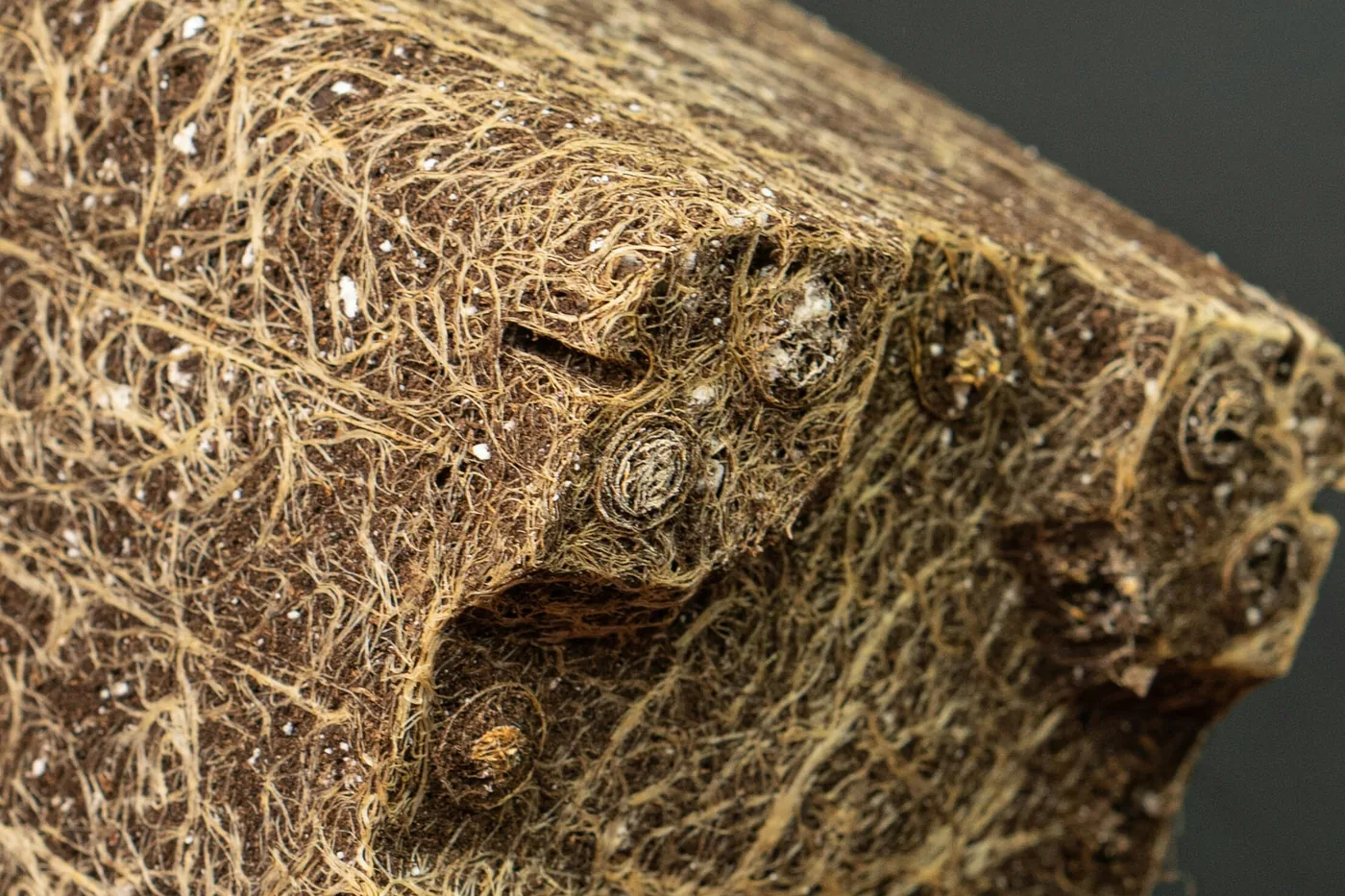
So the first question is never how, it is whether. Tip the plant out and look at the base. If you can see separate crowns, separate fans, or shoots coming up out of the compost rather than off a stem, it divides.
Which plants divide, and which do not
Plants that divide share a habit: they make new growing points at or below soil level. Clump-formers, rhizome-creepers, suckering shrubs, most ferns, most grasses, and a good many of the houseplants sold as single specimens.
Plants that do not divide have one growing point and no means of making another at the base. A single-stemmed palm is the clearest case — a kentia or a parlour palm is one stem for life, and what looks like a clump in the pot is several seedlings sown together. Pull them apart and you have several thin palms, which is not what anybody wanted.
- DividesClumps, crowns, rhizomes, suckers, offsets at the base
- Does notOne stem, one growing tip, no basal shoots
- The testTip it out and look for more than one growing point
A plant that will not divide is usually still propagable by another route — a cutting or seed. Each plant page says which.
When to do it
As growth starts. For most plants in Britain that is March to April; for anything flowering in spring, it is straight after flowering instead.
The reason is mechanical rather than traditional. Every division loses roots, and the plant has to rebuild them before it can support its leaves. It can only do that while it is in growth. The same cut that recovers in a fortnight in April sits in cold compost doing nothing in October, by which time rot has a clear run at the damaged surfaces.
Repotting time is the natural moment because the plant is out of its pot anyway, and because a plant that has filled its pot is usually a plant worth dividing.
Getting it apart
Water the plant the day before. A dry rootball is brittle and shatters; a damp one gives.
- 1Tip it out and knock or wash the loose compost off so you can see what you are doing
- 2Find the growing points — crowns, fans, shoots — and decide where the divisions are before you touch anything
- 3Tease the roots apart by hand wherever they will come
- 4Cut only what will not separate, with a clean blade, in one stroke rather than sawing
- 5Trim off anything brown, hollow or smelling sour before it goes back in compost
Washing the compost off feels drastic and is worth doing on anything congested. You cannot divide what you cannot see, and most of the damage done in dividing comes from pulling blind at a solid-looking lump.
What each piece needs
A growing point and roots. Both, on every piece.
That sounds obvious and it is the single thing most often got wrong, because the two are not always in the same place. On an iris the rhizome carries the fan of leaves and the roots hang below it, so a length of rhizome with no fan is dead weight. On a dahlia the eye sits on the old stem, not on the tuber, so a fat tuber snapped off cleanly will never grow — it has stored food and nothing to spend it.
Bigger pieces establish faster. The temptation with a large clump is to get six plants out of it. Three will be in flower a year sooner.
Replanting, and the fortnight afterwards
Pot each piece into a container that just fits it. A division sitting in a large pot of wet compost is the classic way to rot one, because the roots it has left cannot dry the compost out.
Then: out of direct sun, compost just damp, and nothing else. No feed — there are no roots to take it up and it will scorch what roots there are. No misting-into-submission. The plant is rebuilding underground where you cannot watch, and the main risk in the fortnight after dividing is being helped too much.
Some wilting is normal for a few days, because the leaves are asking for more water than the remaining roots can deliver. If it is severe, take off some of the oldest leaves rather than adding water. Wet compost and a drooping plant is the pattern to recognise.
The ones that sulk
A few plants divide perfectly well and then look terrible for a season. That is not a failure and it is worth knowing in advance, because the usual response — more water, more feed, a bigger pot — makes all three of them worse.
- Maidenhair fernBrowns off almost entirely, then reshoots from the base
- Bird of paradiseCan take a full year to flower again after any root disturbance
- PeonyResents it for two or three years; plant the eyes shallow or it will not flower at all
- CalatheaSulks visibly; divide only into pieces of three or more leaves
The common thread is that all four are slow to rebuild roots. Against that, an aspidistra or a hosta can be cut in half with a spade and will not notice.
Common questions
When is the best time to divide a plant?
As growth starts, which for most plants means early spring. The piece you cut off has lost part of its root system and has to rebuild it, and it can only do that while it is growing. A division made in autumn sits in cold compost with a damaged root system and no way to repair it, which is why the same cut that succeeds in March fails in October.
How small a piece can I take?
Each piece needs at least one growing point and some of its own roots. A growing point is a crown, a shoot, a fan of leaves or a bud, depending on the plant. Roots alone will not make a shoot and a shoot alone will not make roots, so a piece with only one of the two is not a division, it is a casualty. Bigger pieces establish faster; three good divisions beat nine poor ones.
Should I cut or pull it apart?
Pull where it will, cut where it will not. Many clumps come apart in the hands once the compost is washed off, and a torn root heals better than a cut one. A dense crown needs a knife, and the damage is acceptable because the alternative is destroying more of it by force. Two forks back to back are for border perennials, not for pots.
Why did my divided plant collapse afterwards?
It lost roots and kept all its leaves, so it cannot take up enough water to supply them. That is why a wilting division is usually a watering problem in reverse: the compost is wet and the plant is still thirsty. Keep it out of direct sun, keep the compost just damp, and if it is badly wilted, remove some of the oldest leaves to reduce what the roots have to support.
Can I divide a plant that is flowering?
You can, but it will drop the flowers. The plant is holding them up with water it is about to lose, and it will abandon them to save itself. On anything grown for its flowers, divide after flowering, not before. On a foliage plant it does not arise.
Plants in the catalogue divided this way
Division is the primary method for 62 plants in the library. Each page gives the timing and the one thing that differs for it.
- Peace Lily Spathiphyllum wallisii
- Prayer Plant (Calathea) Goeppertia orbifolia
- Boston Fern Nephrolepis exaltata
- Chinese Evergreen Aglaonema commutatum
- Mint Mentha spicata
- Bird of Paradise Strelitzia reginae
- Areca Palm Dypsis lutescens
- Flamingo Flower Anthurium andraeanum
- Prayer Plant (Maranta) Maranta leuconeura
- Asparagus Fern Asparagus setaceus
- Chives Allium schoenoprasum
- Oregano Origanum vulgare
- Cast Iron Plant Aspidistra elatior
- Maidenhair Fern Adiantum raddianum
- Caladium Caladium bicolor
- Button Fern Pellaea rotundifolia
- Lady Palm Rhapis excelsa
- Venus Flytrap Dionaea muscipula
- Pansy Orchid Miltonia roezlii
- Easter Orchid Cattleya mossiae
- Rabbit's Foot Fern Davallia fejeensis
- Holly Fern Cyrtomium falcatum
- Bamboo Palm Chamaedorea seifrizii
- Calla Lily Zantedeschia aethiopica
- Bamboo Phyllostachys aurea
- Gerbera Daisy Gerbera jamesonii
- Catnip Nepeta cataria
- Shamrock Plant Oxalis triangularis
- Primrose Primula vulgaris
- Iris Iris germanica
- Dancing-Doll Orchid Oncidium flexuosum
- Golden Shower Orchid Oncidium sphacelatum
- Christmas Orchid Cattleya trianae
- Cocktail Orchid Cattleya forbesii
- Brazilian Orchid Sophronitis species
- Lace Orchid Odontoglossum crispum
- Spikemoss Selaginella kraussiana
- Roosevelt Fern Nephrolepis biserrata
- Duffii Fern Nephrolepis cordifolia
- Old World Orchid Bulbophyllum appendiculatum
- Lily-of-the-Valley Orchid Odontoglossum pulchellum
- Miniature Lady Palm Rhapis flabelliformis
- Tarragon Artemisia dracunculus
- Lemon Balm Melissa officinalis
- Lemongrass Cymbopogon citratus
- Roman Chamomile Anthemis nobilis
- Sorrel Rumex scutatus
- Peony Paeonia officinalis
- Dahlia Dahlia
- Hosta Hosta plantaginea
- Lovage Levisticum officinale
- Cardinal Flower Lobelia cardinalis
- Rhubarb Rheum rhabarbarum
- Gloriosa Lily Gloriosa superba
- Butterfly Iris Iris spuria
- Canna Lily Canna generalis
- Hops Humulus lupulus
- Coral Bells Heuchera sanguinea
- Snowdrop Galanthus nivalis
- Buttercup Ranunculus spp.
- Emerald Feather Fern Asparagus densiflorus
- Nandina (Heavenly Bamboo) Nandina domestica
The method is decided by how a plant grows, not by what you would prefer. If yours is not on this list, it will be on one of the others: cuttings, seed, offsets and pups, layering, plantlets and runners, or ferns.
Still not sure?
The RHS's propagation advice is the general reference; this page is the houseplant and container case of it.
Sabz will not tell you when to divide a plant. That is a job with the rhythm of a season, and the app is built around recurring care. What it does is keep the watering right for the species while a division is re-rooting, and read your own care history back when something goes wrong. Several of the plants above are toxic to cats or dogs, and their pages say which, from that species' own ASPCA entry.
 Free to start. No account, no analytics.