Guides · Yellow leaves · Autumn
Why are my plant’s leaves turning yellow?
Yellow leaves are the plant’s one all-purpose signal, which is why the internet gives you fifteen reasons for it. But where the yellow starts, and what the rest of the plant is doing, narrows it to three: the oldest leaves going first, the newest leaves coming in pale, or yellow in patches. One of those needs nothing done at all. Here is how to tell them apart, and what to do about each.
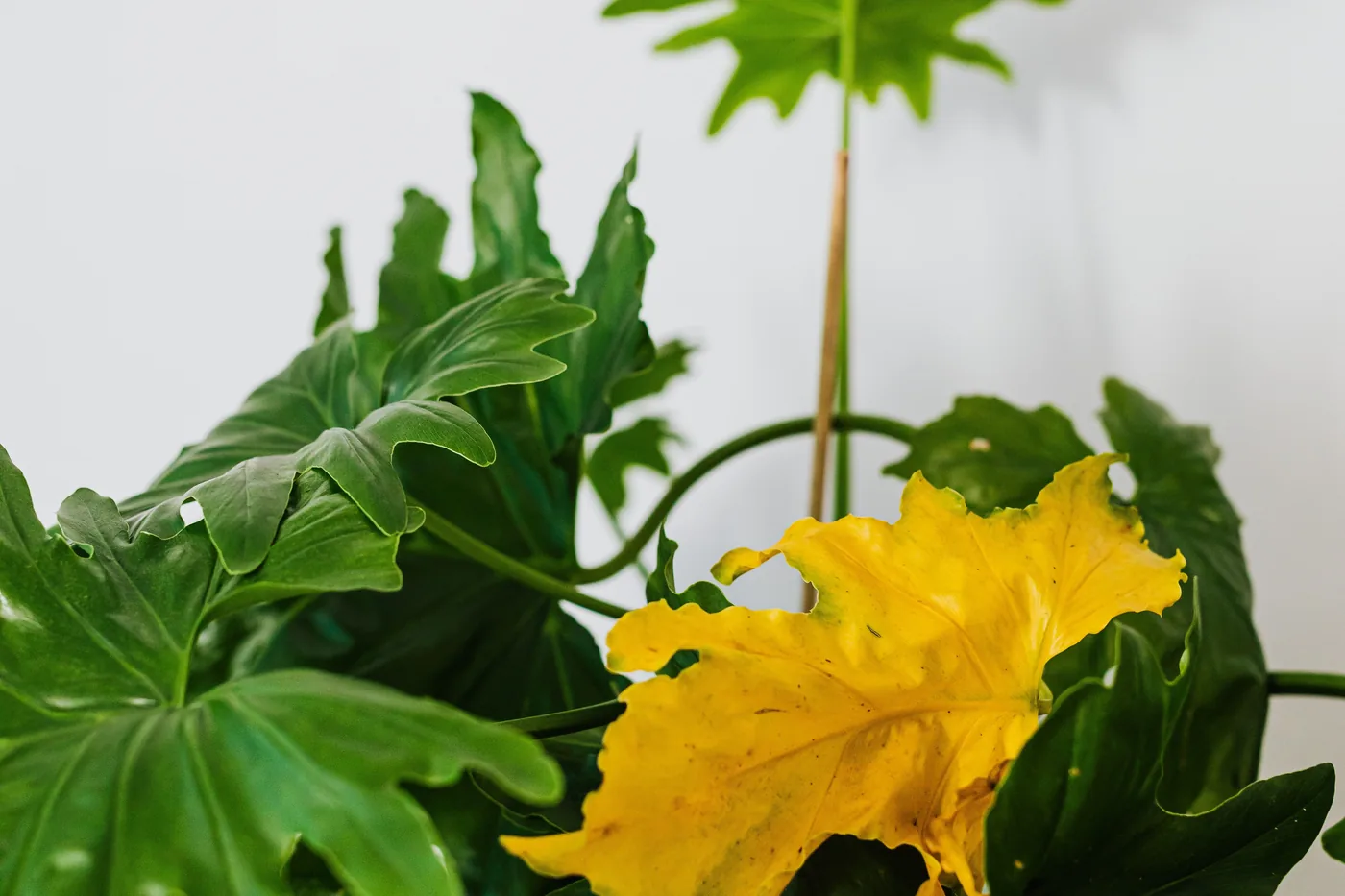
- Oldest leaves, from the bottom
- Age if it is one now and then; overwatering if several, soft, and the soil is wet
- Newest leaves, pale or yellow
- Hungry, or short of light. The plant cannot build green
- Patches, spots, or one side
- Sun scorch, a draught, or a fungus. Look at where the plant sits
Read the pattern first
Before you change anything, look at three things. Which leaves are yellow: the old ones at the bottom, the new ones at the top, or leaves all over? How they are yellow: evenly, from the edges, in patches, or with green veins left behind? And what the soil is doing: push a finger in, because a wet pot and a dry pot with the same yellow leaf are two different problems.
That is the whole method. The sections below take the three patterns in turn, and the app does the same thing, with the advantage that it also knows how often you have actually watered.
Old leaves, from the bottom
The commonest pattern, and the one most often overtreated. The lowest, oldest leaves yellow and eventually drop, while the top of the plant looks fine.
Just age if
- it is one leaf, or one every few weeks
- the leaf yellows evenly and lets go cleanly
- new growth at the top is firm and green
- the soil dries out between waterings as usual
Overwatering if
- several lower leaves go at once, and they go soft, not crisp
- the plant droops even though the soil is damp
- the compost smells sour, or stays dark for days
- there are small flies around the pot
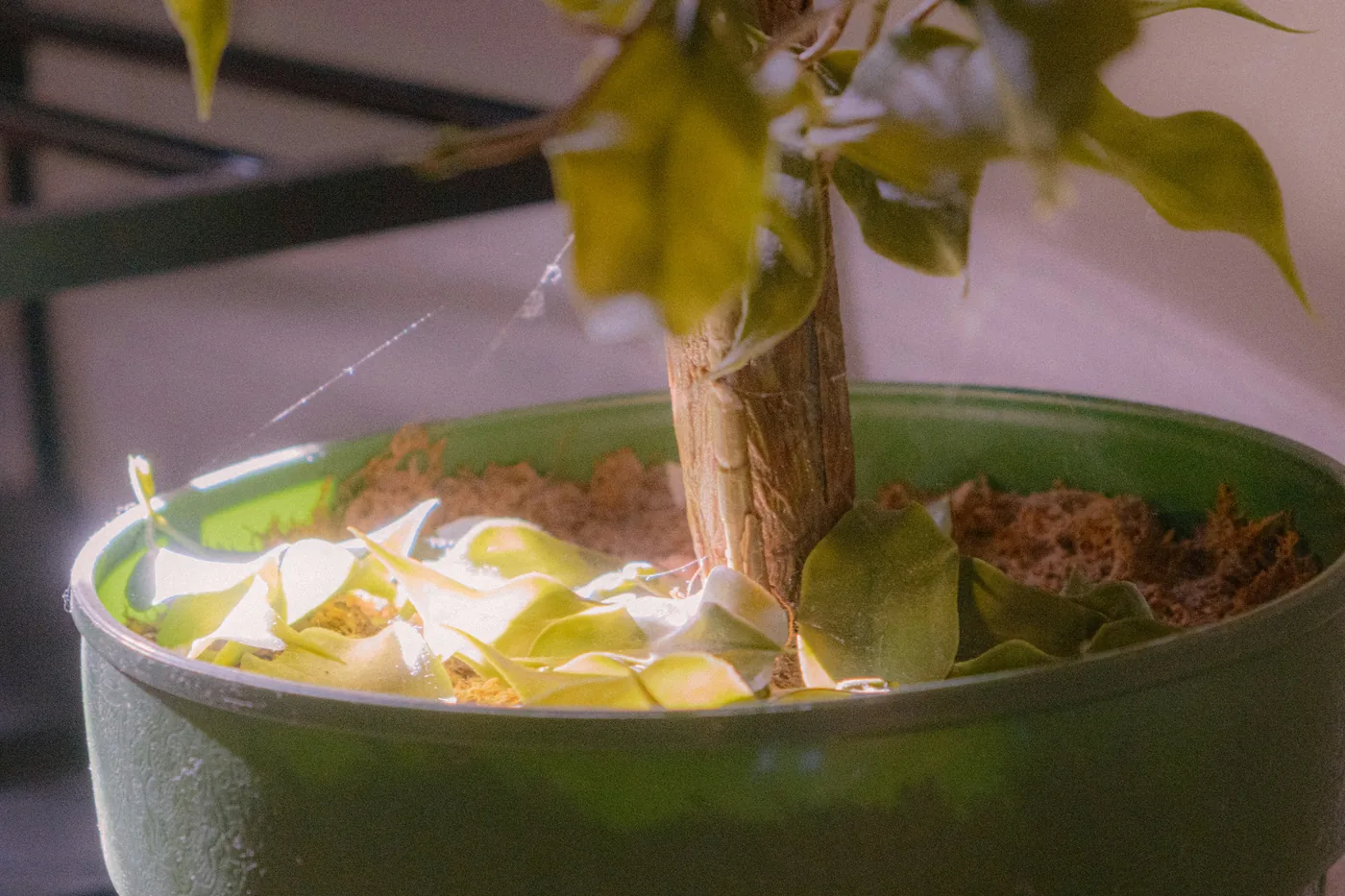
A plant sheds its oldest leaves as it grows; that is a plant working, not failing. Take the spent leaf off and carry on. If it is the second column, the roots are sitting wet and short of air, and the fix is to stop watering and let it dry properly: the overwatering guide takes it from there, including the version for a self-watering pot.
New leaves, pale or yellow
When the newest growth comes in pale, small, or yellow, the plant is not shedding. It is failing to build green, and there are two reasons a plant cannot.
It is hungry
A plant that has sat in the same compost for a year or two has used what was in it. New leaves come in pale, sometimes yellow between green veins, and growth slows. The fix is a balanced liquid feed at the strength on the pack, during the growing season, and fresh compost if it has been years. What the fix is not: doubling the dose to catch up, or feeding a plant whose soil is bone dry. Water first, then feed.
It is short of light
In low light the plant stretches towards the window, the stems get long and thin, and the new leaves are small and pale. If the pot is more than a couple of metres from a window, or the window faces north, this is the one. Move it closer, turn it every week or two, and expect the next leaves, not the existing ones, to show the difference. Do not water more to compensate: a plant in low light needs less, not more, and that is how this pattern turns into the overwatering one.
Telling the two apart: a hungry plant is usually in a bright enough spot but has not been fed or repotted; a light-starved one is stretched and leaning. If it has been fed and it is leaning, it is light.
Yellow in patches, or on one side
Uneven yellow points at something the plant is sitting next to.
- Bleached, papery patches on the side facing the window, sometimes with brown burnt centres: too much direct sun, usually on a plant that wants bright but indirect light. Move it back or hang a sheer curtain. The patches will not recover; new leaves will come in clean.
- Sudden yellowing and drop after a move, a repot, or the first cold nights: a draught, cold glass, or a radiator. Move it away from the door, the window pane, and the heat. It settles in a week or two.
- Yellow rings around dark spots: a leaf-spot fungus, which likes wet leaves and still air. Take off the worst leaves, stop misting, and give it more space and airflow.
- Yellowing with brown, crispy tips: dry air or hard water rather than a yellowing problem at all. That is the brown tips page.
- Yellow with small flies rising from the pot: the flies are fungus gnats, and they and the yellow share a cause, compost that never dries. Their page, then the overwatering one.
What to do, by pattern
- One old leaf now and then
- Take it off once it is fully yellow. Change nothing. Judge the plant by its new growth.
- Several old leaves, soft, soil wet
- Stop watering and let the top few centimetres dry properly, move it somewhere brighter and warmer, tip out any standing water. If the base is soft or the soil smells, check the roots. Full steps on the overwatering page.
- New leaves pale, plant not leaning
- Water, then feed with a balanced liquid feed at pack strength. Feed through spring and summer only; pause from autumn. If it has not been repotted in two years, fresh compost does more than any feed.
- New leaves pale, plant stretched towards the light
- Move it to within a metre of a bright window, out of direct midday sun. Turn it weekly. Water less while it adjusts.
- Patches on the sunny side
- Move it back from the glass or diffuse the light. Trim the worst leaves once it is settled.
- Sudden, after a move or a cold snap
- Away from draughts, cold windows and radiators. Leave it alone for a fortnight before judging.
What not to do
- Do not water a yellow leaf. Yellow is not a request for water, and most yellowing houseplants are already too wet.
- Do not feed a plant that is yellowing from the bottom in wet soil. Fertiliser in waterlogged compost burns what roots are left.
- Do not do three things at once. Change one thing, wait two weeks, look at the new growth. If you move it, feed it and repot it in the same weekend, you will never know which one worked, and the plant will resent all three.
- Do not cut off leaves that are still mostly green. A half-yellow leaf is still feeding the plant; take it once it has gone.
- Do not panic over a lower leaf in autumn. Less light means less leaf, and a plant trimming its own canopy for winter is doing the sensible thing.
This page names categories, not products, on purpose. Availability and approval change; what works does not.
Common questions
Why are my plant's leaves turning yellow?
Most often too much water for the season, especially if the lowest leaves go first and the compost is still damp days after watering. Next most often it is simply age — a plant sheds one or two old leaves at the bottom as it grows — and in autumn, less light. Yellow between the veins on new leaves points at feeding rather than water.
Should I cut off yellow leaves?
Yes, once a leaf is fully yellow it will not turn green again, and removing it lets the plant put its effort into new growth. Cut at the base of the leaf stalk with clean scissors. A leaf that is only partly yellow can stay until it has finished; the plant is still drawing the goodness out of it.
Can yellow leaves turn green again?
Rarely, and only if the yellowing is early and caused by something you fix quickly, such as a nutrient shortage. A leaf that has gone fully yellow is finished. What recovers is the plant, not the leaf: the new growth will come in green once the cause is corrected.
Why are the leaves yellowing in autumn when the plant was fine all summer?
Light drops fast from late August, the plant slows down, and the watering that was right in July is now too much. The plant also lets go of some older leaves it can no longer support in less light. Water less often, and expect a little shedding; it is normal unless it spreads to the new growth.
Do yellow leaves mean too much water or too little?
Either, and the leaf alone will not tell you. Feel the compost: damp days after watering means too much, dry and pulling away from the pot means too little. Soft yellow leaves with damp compost is the commonest combination in a house; crisp yellow tips with dry compost is the other.
Plants this often affects
Species in the Sabz catalogue whose common problems include this one. Each page has the watering interval and the toxicity verdict for cats and dogs.
- CyclamenCyclamen persicum
- Lucky BambooDracaena sanderiana
- Moth OrchidPhalaenopsis hybrid
- OleanderNerium oleander
- AzaleaRhododendron simsii
- BlueberryVaccinium corymbosum
- Cabbage PalmCordyline australis
- Calamondin OrangeCitrus mitis
- CamelliaCamellia japonica
- Canary Island Date PalmPhoenix canariensis
- China AsterCallistephus chinensis
- English LavenderLavandula angustifolia
- GardeniaGardenia jasminoides
- GladiolusGladiolus species
- Gloriosa LilyGloriosa superba
- HeatherCalluna vulgaris
- IxoraIxora javanica
- JasmineJasminum species
- Leopard OrchidDendrobium gracilicaule
- LovageLevisticum officinale
- Majesty PalmRavenea rivularis
- Mistletoe CactusRhipsalis baccifera
- ParsleyPetroselinum crispum
- PetuniaPetunia hybrida
- PierisPieris japonica
- PrimrosePrimula vulgaris
- Roosevelt FernNephrolepis biserrata
- RoseRosa
- Silver Table FernPteris cretica
- SnowdropGalanthus nivalis
- Sweet AlyssumAlyssum spp.
- Windmill PalmTrachycarpus fortunei
- WisteriaWisteria
Still not sure?
If the yellowing comes with a soft base and a sour smell, read root rot next. The RHS's page on leaf damage on houseplants covers the rarer causes this page leaves out.
Sabz’s Check-up asks exactly these questions, and it has one thing this page does not: your watering history. Pick Yellowing lower leaves or Yellowing new or all leaves, answer the soil question honestly, and it weighs age, water, food and light against what you have actually logged, then gives you the plan above for your plant.
 Free to start. No account, no analytics.