Christmas guide · Cats and dogs
Which Christmas plants are actually dangerous to cats and dogs?
The verdict, at a glance
The plant most people worry about at Christmas is the one that matters least. Poinsettia’s reputation is largely undeserved — the ASPCA’s own entry calls it “generally over-rated in toxicity”. Meanwhile cyclamen and amaryllis, which almost nobody worries about, are the two on this page that can make an animal genuinely ill. Here are the seven plants most likely to be in a British house at Christmas, with cats and dogs judged separately, each read off that species’ own ASPCA record — or, in mistletoe’s case, off the finding that no such record exists.
The next plant may surprise you too
Sabz keeps this same per-animal verdict — cat and dog judged separately — for every plant in your own collection, free to start and with no account.

Poinsettia: the myth, and what is actually true
Poinsettia
“Irritating to the mouth and stomach, sometimes causing vomiting, but generally over-rated in toxicity.” — ASPCA
What that means in practice: a cat or dog that chews a poinsettia leaf may drool, may be sick, and is very unlikely to be seriously harmed. The milky sap irritates skin and mouths — that is the mechanism, and it is the same mechanism that makes the plant unpleasant enough that most animals stop after one bite.
None of this makes it a good idea. An irritant is still an irritant, a sick cat is still a sick cat, and a plant out of reach is better than a plant being chewed. But if your cat has had a nibble and you are deciding whether this is an emergency, the honest answer is that it is usually not — while the cyclamen on the same windowsill would be.
English ivy
“Vomiting, abdominal pain, hypersalivation, diarrhea. Foliage is more toxic than berries.” — ASPCA
Ivy is the one that arrives as a wreath or a table garland rather than in a pot, which is why it gets forgotten. It ends up at eye level for a cat and within easy reach of a dog, and it stays there for a fortnight. The leaves matter more than the berries — the opposite of what most people assume, and worth knowing if you are deciding which end of the garland to move.
Holly
“Vomiting, diarrhea and depression. Leaves and berries are low toxicity.” — ASPCA
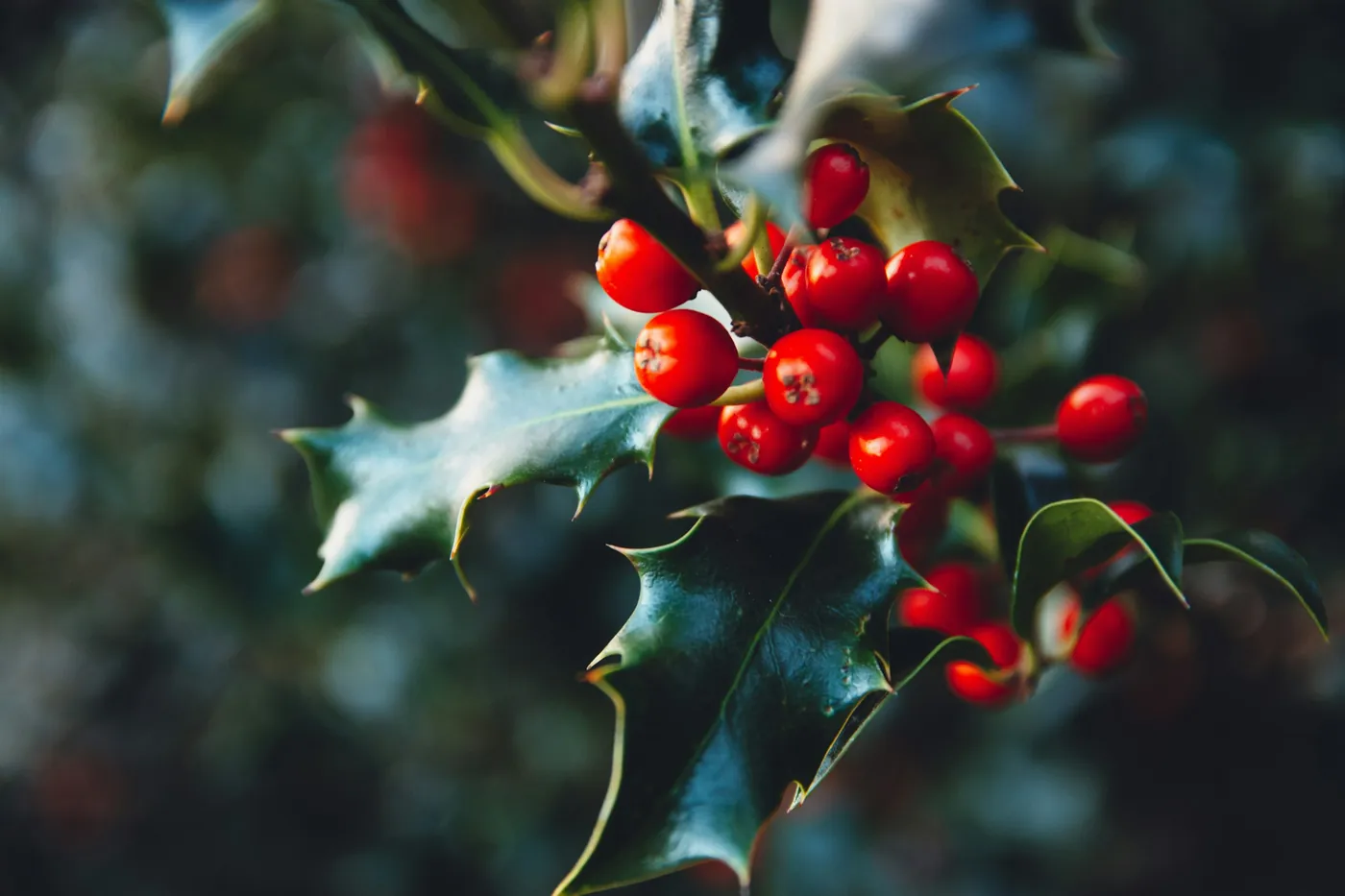
The toxic principle is saponins, and the ASPCA’s own wording — low toxicity — is why holly grades the same as poinsettia rather than worse. In practice the spines are the more immediate problem. A dog that takes a mouthful of a holly sprig is far more likely to arrive with a pricked mouth than with saponin poisoning, and that is the thing most owners have never been told.
The berries are the part an animal or a small child reaches for, and only female hollies carry them, and only with a male plant nearby to pollinate. A berried wreath is therefore cut material brought into the house, not something growing in a pot — the ivy problem again: it hangs at head height for a fortnight and nobody thinks of it as a plant.
ASPCA files Ilex aquifolium under the same record as English and European holly. American holly is Ilex opaca, a different species with slightly different signs, and was not used.
The two worth moving out of reach
Amaryllis
“Vomiting, depression, diarrhea, abdominal pain, hypersalivation, anorexia, tremors.” — ASPCA
The bulb forced indoors for Christmas flowers. The bulb is the most concentrated part, and it is the part that sits in a pot at floor level looking like something to dig.
Cyclamen
“Salivation, vomiting, diarrhea.” For large amounts of the tuber: “heart rhythm abnormalities, seizures, death.” — ASPCA
The pink and white flowering pot plant sold all winter. This is the most serious plant on the page and the one fewest owners have ever been warned about.
Both are worth putting somewhere an animal cannot reach — not because a nibble is likely to be fatal, but because the consequences run further than they do for anything else here.
Mistletoe: the fourth state
No record for cats. No record for dogs. Which is not the same as safe.
There is no ASPCA entry for Viscum album, the mistletoe sold in Britain at Christmas. That is not an oversight on our part: the A, E, H, I, M and V letter indexes were scraped to full depth — 220 slugs — and no record for Viscum album or European mistletoe exists in any of them.
The ASPCA does list a mistletoe, and it is a different plant. Phoradendron flavescens, American mistletoe, is a separate genus, and its record is a serious one: “vomiting, diarrhea, low blood pressure (rare), difficulty breathing, low heart rate.” That is not the plant hanging in a British doorway, and carrying its verdict across a genus boundary would put a severe warning on a species we have no evidence about.
So the honest answer is that nobody knows. What follows from it:
- Treat it as unknown, not as safe. Keep it out of reach on the same reasoning you would use for any plant with no safety record.
- If your animal eats any, ring your vet and say it was European mistletoe, Viscum album — not simply “mistletoe”, which will be taken for the American one and may change what you are told.
- The berries are the part an animal goes for, and a sprig hung in a doorway is at least usually above a cat’s reach. That is luck, not a safety feature.
What to do if your pet has eaten one
Ring your vet. That is the whole answer, and nothing on this page replaces it. Three things that help when you do:
- Take a piece of the plant with you, or a photograph of it. Identification is most of the problem, and a leaf in a bag answers it instantly.
- Say how much and when, as far as you know. “A single leaf twenty minutes ago” and “the bulb, some time this afternoon” lead to different advice.
- Do not try to make your pet sick. At home it can cause more harm than the plant did.
If you are not sure whether it warrants a visit, the Animal PoisonLine — run by veterinary poison specialists, 24 hours — is the UK triage service for pet owners. It is a paid service, worth knowing before you ring.
01202 509 000What you can have instead
Christmas cactus
Not recorded as toxic to cats or dogs, flowers across midwinter, and one of the easiest houseplants there is to keep alive. If you want one plant on the windowsill that nobody has to worry about, it is this one.
Our plants safe for cats and dogs list has the rest.
Where these verdicts come from
Every verdict on this page is read from that species’ own record with the ASPCA, with cats and dogs judged separately rather than lumped together as “pets” — because they genuinely differ, and a page that gives one answer for both is hiding that.
A plant not listed as toxic is not the same as a plant proven safe. Some species have no entry at all; where that is true, our species pages say unlisted rather than implying a clean bill of health. Mistletoe on this page is that case, live. It would have been easy, and wrong, to borrow the American mistletoe’s verdict because the common name matches. We did not, and the row says so.
Pet-safety information is a general guide from the ASPCA's toxic-plant database and covers cats and dogs only. The symptoms quoted are those ASPCA lists for each plant; how an animal actually reacts depends on how much it ate and on the animal. It isn't exhaustive, isn't veterinary advice, and individual animals vary — never rely on it as the sole basis for a decision about your pet. If you think your pet has eaten a harmful plant, contact a vet immediately.
Keep every plant’s verdict in your pocket
Sabz keeps the toxicity verdict on every plant in your own collection, per animal, so the question does not have to be looked up in a hurry on Christmas Eve. Free to start. No account, no analytics.